Because all types of peonies can be incredibly long-lived, yet relatively care-free perennials, its important to start with vigorous nursery stock and site a new planting in an area where it will thrive.
All types of peonies need:
Fertile, well-drained soil with a mildly-acid to neutral pH of 6.5-7. Never plant a peony in a soggy area or an area which has standing water for any length of time.
All types of peonies will grow in the full sun. A minimum of 6 hours of sun is required for good growth on herbaceous and intersectional peonies. Tree peonies thrive in the full sun with robust growth, the disadvantage to planting them there is the flower fade very quickly.
Tree peonies will also grow and flower well in areas of dapled sunlight or and eastern exposure which recieves morning sun and afternoon shade. Growth will be a bit slower than in the full sun, but the flowers will last longer.
If you garden in area with heavy clay soils, depleted soils, and/or highly acidic (low pH) soils, never fear, you can still grow beautiful peonies once you take the proper steps to amend the soil in the new peony planting area. Basically, this entails adjusting the soil’s pH to the proper level, ceating looses, more fialble soil in areas of heavy clay and adding adequate organic material to deficient soils so that the peony will be provided with long-term nourishment. A little work now will pay you back with years of beautiful flowers. We hope the below video and illustrated step-by-step will be helpful in helping you to create the an optimal area to plant peonies. Should you have any questions, please email us at....
In this video, Dan Furman of Cricket Hill Garden demonstrates step-by-step how to prepare a new planting area using a no-till method.
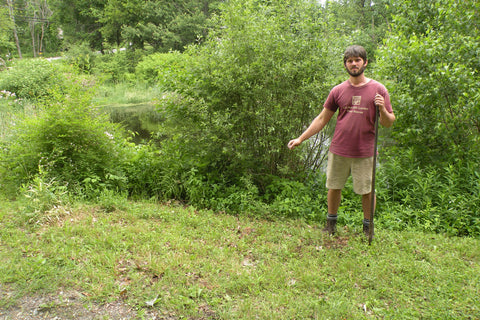
Step-by-step for preparing a new peony bed for fall planting in a law or unimproved area:
If you are planting peonies in a new garden area, choose a location with 6 hours of sun (tree peonies will also grow well in dappled shade, but if you are planting herbaceous or intersectional ponies, select a full sun location.) The other basic requirement for peonies is a well drained site.
When planting garden bed, make sure that the soil is deep enough to accommodate a peony’s extensive root system. Don’t worry if the soil is rocky, just don’t plant in an area with only a few inches of soil above a boulder or rocky ledge.
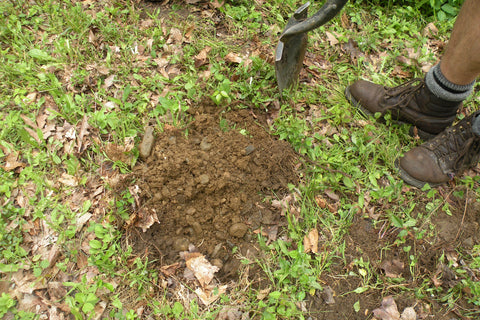
In New England, our soils tend to be sandy and rocky, as well as low in calcium and phosphorus. In our area the native soil’s pH is around 5.0 to 5.5, much too low for successful peony cultivation. Poor soils can be amended to improve fertility. Its always a good idea to have your soil tested so that you know your soil’s baseline mineral and fertility levels.
For heavy clay soils with poor drainage, peonies should be planted in raised beds or mounds. Many garden areas are improved by making raised beds .
The following is a deluxe method for amending unimproved,
poor native soil if you are creating a new planting area.
We add 2 lbs each of the following soil-building amendments to our planting site sized 3′ x 3'
Hi-Cal (Calcitic) Lime- For calcium, this also raises the pH of the soil, 6.5-7.0 is ideal for peony growing. This is needed if your native soil is acidic.
Colloidal Phosphate- For short-term calcium boost and slow-release phosphorus, very important for bloom production.
Greensand- For improving soil texture and adding potassium.
We add 1 lb. each of the amendments listed below for building high levels of humus:
Alfalfa meal
Blood meal
Bone meal
These amendments can be found through suppliers like Espoma and Dr. Earth which package for the home gardener, sold online or locally at well stocked garden centers.
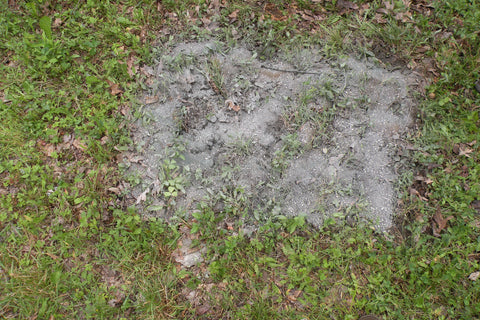
Mix all of your amendments together and spread them over a 3′ x 3′ area.
Rather than rotor-till a new planting area, we like to smother the grass and unwanted plants. By not disturbing the soil, we leave the complex web of beneficial bacteria and fungi intact.
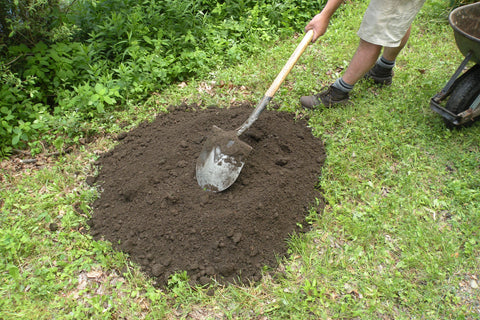
One large wheel barrow full of finished compost achieves two goals, it adds organic material to the planting area and will also smother the unwanted grass.
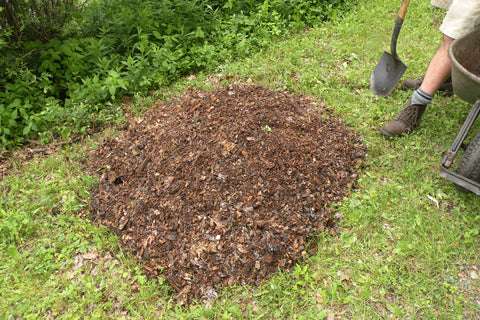
Top off the compost pile with a wheelbarrow load of mulch. We have lots of old wood chips around the garden, so we use these. You might also consider using grass clippings or leaves.
Allow the soil amendments, compost and mulch to sit over the next few months. In the fall, when you are ready to plant, pull back the mulch and compost from the center of the pile and plant your peony there. All of the good compost and mulch will nourish the peony and get it off to a great start.
If your garden area has better soil and has been worked before, a simpler method which will yield good results would be to add 1- 2 lbs Azomite and one wheelbarrow load of compost to the future planting area sized 3′ x 3′. If you know your soil is acidic, add 1-2 lbs. of ground limestone. Allow this to sit and ‘stew’ for a few weeks if posssible and in early fall your soil will be ready for planting.